Digital Dialogues
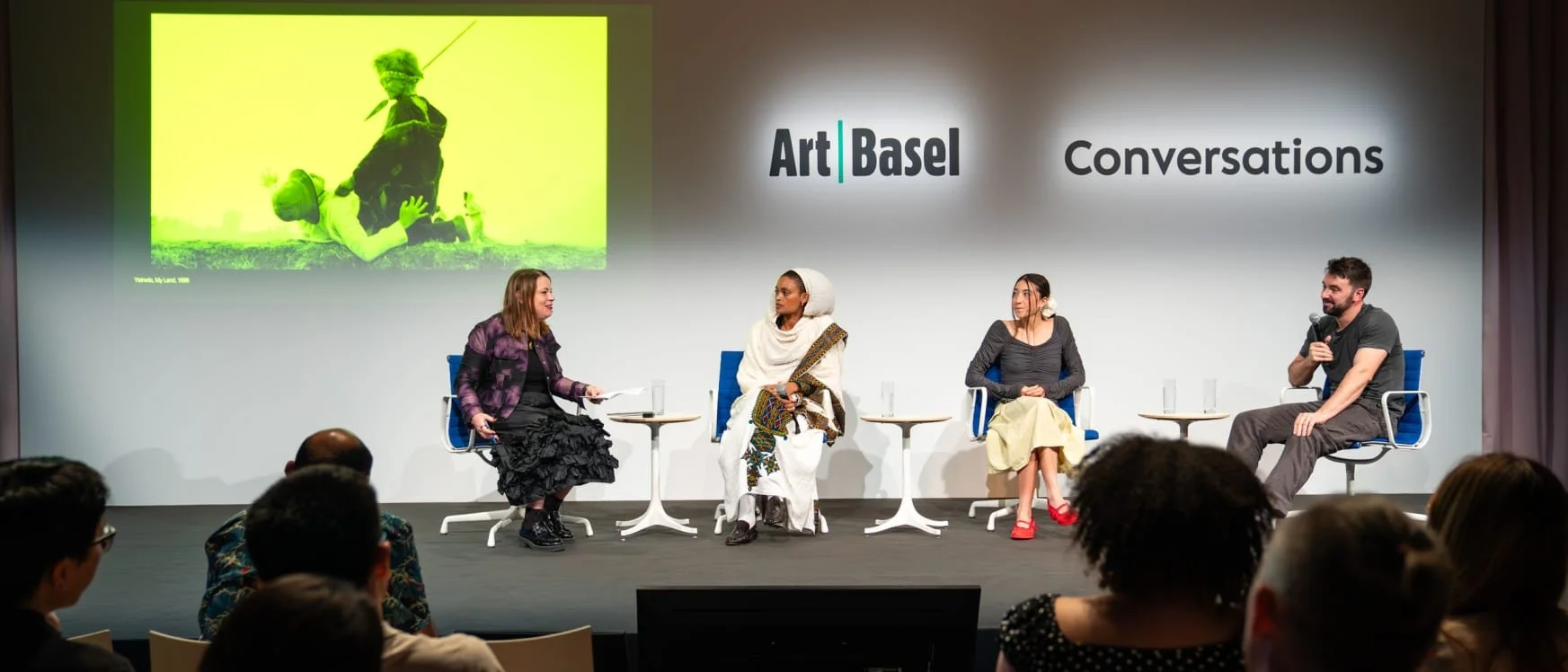
Infinite scroll: Art, algorithms and images today
Maya Man, Artist, New York
Kiya Tadele (Yatreda), Artist, Addis Ababa
Jack Butcher, Artist, Nashville
Moderator: Dr. Jeni Fulton, Head of Editorial, Art Basel
This panel brings together artists who shape – and are shaped by – the internet’s visual vernacular to ask how art is made for feeds, from formats, and through platforms.
Maya Man examines online identity and performance with works that inhabit the browser, the timeline, and the closet. Projects such as the browser-extension Glance Back and the Art Blocks series ‘FAKE IT TILL YOU MAKE IT’ interrogate femininity, authenticity, and algorithmic self-presentation. Jack Butcher’s practice explores how value emerges in networked culture. As founder of Visualize Value, he distills markets, scarcity, and consensus into minimalist visual systems, making the shape of the digital economy visible. Yatreda, an Ethiopian family-based digital art collective, weaves together nostalgic tizita aesthetics, oral histories, and blockchain-native formats to reframe heritage through the lens of the networked image.
Together they discussed making with/against algorithms; the aesthetics of compression, glitches, and file types; how distribution channels (Instagram/TikTok/marketplaces) become mediums; and the ethics of mining, mirroring, and remixing online culture.
.
Ben Davis, National Art Critic Artnet News, New York
Cécile B. Evans, Artist, La Plaine Saint Denis
Moderator: Dr. Jeni Fulton, Head of Editorial, Art Basel
Artificial intelligence and blockchain have already begun to change how we make, show, and value art, and led to the creation of entirely new cultural communities. Technology’s impact will only accelerate in the years to come, bringing radically new perspectives on questions surrounding creativity, originality, cultures, and values. This debate explores the pitfalls and upsides of expanding the boundaries of the traditional art world and speculates on how technology might revamp avant-garde artmaking and viewing.
Cécile B. Evans lives and works in La Plaine Saint-Denis. They have previously exhibited at Centre Pompidou, Tate Liverpool, Lafayette Anticipations, Whitechapel Gallery, Haus der Kunst, and Singapore Art Museum, among others. Evans’s films have been screened in festivals such as the New York Film Festival and the International Film Festival Rotterdam. Evans’s work is held in public collections including the Museum of Modern Art and Whitney Museum of American Art in New York City; Centre Pompidou, Paris; Louisiana Museum of Modern Art, Humlebæk; and the National Museum of Modern and Contemporary Art, Seoul.
Ben Davis is the author of 9.5 Theses on Art and Class (Haymarket, 2013), which ARTnews named one of the best books of the decade in 2019, and Art in the After-Culture (Haymarket, 2022), named an art book of the year by The New York Times and the Times Literary Supplement. He has been the national art critic for Artnet News since 2016. In 2019, Nieman Journalism Lab reported that he was the fifth most influential art critic in the United States.
Technology: Expanding, or erasing, the art world?
From nature to networks: Algorithmic ecosystems
Sofia Crespo and Feileacan Kirkbride McCormick, artists, Entangled Others, Lisbon
Linda Douniea, artist and designer, Dakar, Senegal
Moderator: Dr. Jeni Fulton, Head of Editorial, Art Basel, Basel
This panel explores the fascinating intersection of computational systems and the natural world, with a special focus on how artists are using algorithms to reimagine biological forms and ecological relationships. A new generation of artists is creating a ‘synthetic natural history’ through machine learning, training neural networks on datasets of natural specimens to create entirely new lifeforms that feel strangely familiar yet otherworldly. What questions can be asked here about evolution, the imaginary, and other intelligences? This panel will explore what it means to create parallel evolutionary paths.
AArt Basel Miami Beach 2024, December 6th
Kevin Abosch (Artist)
Sougwen Chung (Artist)
Jeni Fulton (Head of Editorial, Art Basel)
Over the last three years, the so-called “AI explosion” has led to artists using AI in ever-more intriguing ways, combining surrealist approaches with filmic techniques borrowed from Hollywood, and pushing the boundaries of human creative expression in new directions. Likewise, using collections of information or data, artists create new and unusual narratives via algorithms in a variety of mediums. This panel unites AI artists Sougwen Chung and Kevin Abosch, who are at the forefront of the genre.
Creating with AI
Art Basel in Paris 2025, October 25
William Mapan, Artist, Paris
Philippe Bettinelli, Curator, New Media Department, Musée National d’Art Moderne – Centre Pompidou, Paris
Moderator: Dr Jeni Fulton, Head of Editorial, Art Basel
Paris has a long history of fostering advanced digital art: Vera Molnár spent most of her life in the city, and the Centre Pompidou has one of the very first collections in the world dedicated to digital media, inaugurated in 1976. Today, curators and institutions such as Jeu de Paume and Centre Pompidou exhibit and collect contemporary digital practices, from NFTs to AI works and beyond, while a new generation of artists and studios draws on research hubs like EnsadLab and IRCAM, and a gallery and museum network that commissions and exhibits work made with code.
This conversation brought together Philippe Bettinelli, curator at the New Media Department at Centre Pompidou, Paris, and Paris-based artist William Mapan to look closely at the city’s current momentum. What mix of institutions, funding, and collector engagement allows digital practices to take root and grow?
From code to collecting–digital art in Paris today
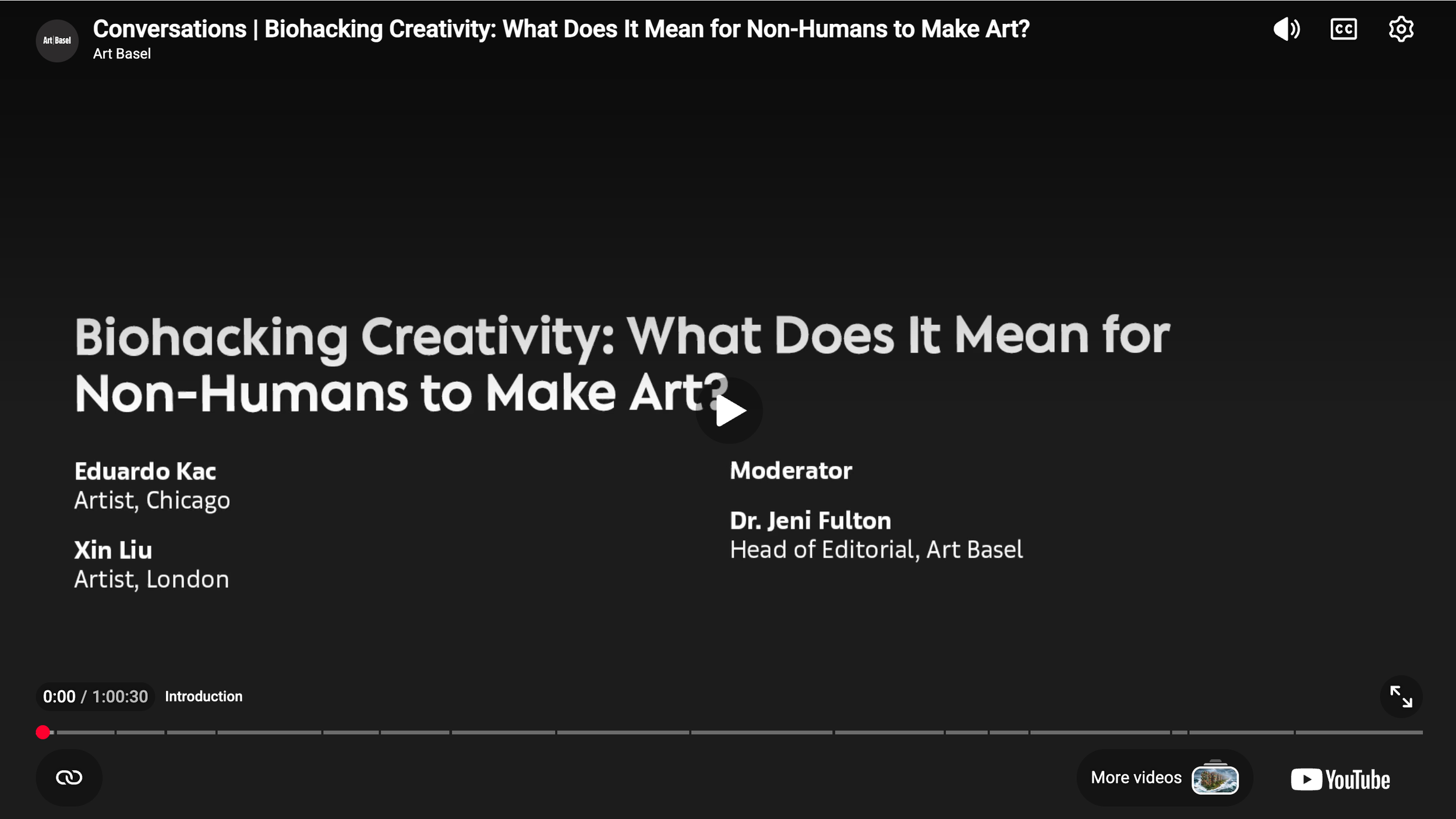
Biohacking Creativity: What Does It Mean for Non-Humans to Make Art?
Art Basel Miami Beach 2023, December 9
Eduardo Kac, artist, Chicago
Xin Liu, artist, London
Moderator: Dr Jeni Fulton, Head of Editorial, Art Basel
Artists are increasingly incorporating bacteria, fungi, and viruses as collaborative agents, using their reproduction and dispersion to drive algorithms which result in complex, immersive artworks. In the context of post-humanism, what does this marriage of technology and biology mean for art and how should these artworks be evaluated?
Eduardo Kac is internationally recognized for his groundbreaking work in contemporary art and poetry. In the early 1980s, Kac created digital, holographic, and online works that anticipated the global culture we live in today, composed of ever-changing information in constant flux. Kac’s singular and highly influential career spans poetry, performance, drawing, printmaking, photography, artist’s books, early digital and online works, holography, telepresence, bio art, and space art.
Xin Liu is an artist and engineer. Xin is the Arts Curator at the Space Exploration Initiative at MIT Media Lab and an artist-in-residence at SETI Institute. Recent institutional solo exhibitions include ‘Seedlings and Offsprings’ at Pioneer Works, New York, and ‘At the End of Everything’ at Artpace, San Antonio. She is an advisor for LACMA Art + Technology Lab and a researcher on the Antikythera program at the Berggren Institute, Los Angeles. Her work has been shown at the Shanghai Biennale; the Thailand Biennale; M+, Hong Kong; Yuz Museum Shanghai, MoMA PS1, New York; MAXXI, Rome; the Sundance Film Festival; Ars Electronica; and Onassis Foundation, New York, among others.